Tuesday, June 10, 2014

Qatar Mall Fire

                   
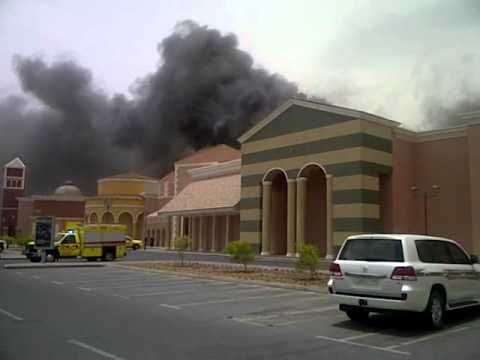
On the morning of 28 May 2012 at around 11am, a fire started at the Villaggio Mall, which is located in the west end of Doha, the capital of Qatar. The mall is very large and has lots of foreign designer shops as well as an indoor theme park with bowling and a rollercoaster.
The fire started at the Nike shop within the mall and engulfed part of the shopping centre. This was later discovered to have been caused by illegal, faulty wiring within a fluorescent light at the shop. The high temperatures probably caused a short circuit in the light fitting. The fire quickly spread to the Gympanzee childcare nursery on the first floor. Tragically the entrances to the nursery became blocked by smoke which meant the 13 children and 4 members of staff were trapped in the nursery area. According to the fire service, the staircase which went up to the nursery also collapsed which made the situation even worse. Reports after the incident showed that the one fire exit that could be used led straight into the fire, and the other one had been locked from the outside. At first, the fire-fighters did not know that there was a nursery inside the mall, but as soon as they found out, they broke through the roof to try and rescue the children and their teachers. Sadly it was too late and the 13 children, 4 teachers and 2 fire-fighters all lost their lives. The children were from across the world, including Spain, Japan and France. Three of the teachers were from the Philippines and one was from South Africa. Three of the children were triplets from New Zealand, meaning tragically that their parents lost all of their children at once.
Ethically this is a terrible tragedy and of course can be called an accident as nobody deliberately started the fire. However, it is not that simple. The statements from witnesses during the fire and the major investigations afterwards show that there were lots of problems and mistakes that caused the fire to spread and the escape and rescue processes to be below the standards they should have been.
People who were at the scene during the fire, said that nobody seemed to know what was going on and that the rescue operation was chaotic. One American witness said that during the fire she could only hear a very quiet sound which was like a buzzer – which was meant to be the fire alarm. There were no alarms in the individual shops. The alarms in the mall were so quiet that many people could not hear them at all. As the smoke inside the mall got worse, there were no louder alarms at all. The witness said that children were still sitting in restaurants eating and nobody was trying to escape. She also said that there were no sprinklers on and nothing to warn people that anything was wrong. Other people at the scene were told to carry on eating their meals, one shopper came out of a changing room and found all the staff had gone and in the VIP area some young men were posing for pictures even though there was thick smoke. Obviously this all shows that there were no plans in place for evacuation, that there were no sprinklers and that the fire alarms were not loud enough. Other issues that were discovered were that there were no correct or detailed floor plans which made life even more difficult for the fire services. The investigation afterwards showed that some sprinklers and alarms had failed to work and the floor plans did not have emergency exits marked correctly.
In June 2013, five people were found guilty of death by negligence. These included the two owners of the day nursery, the chairman of the mall and the deputy manager. They were sentenced to six years in prison and ordered to pay blood money to the families of the victims. Evidence at the trial of those found guilty, discovered that in the past the mall had received many fines for using flammable paint, which of course would have made the fire even worse. The trial also found that the mall owners had ignored requests to look after the fire alarms and sprinklers, which is why many of them were not working. Another problem that came to light was that the fire-fighters had not been properly trained to handle such fires. The one fire exit that the children could have used had been locked from the outside by the mall management. The trial also found that the mall did not have the correct fire fighting equipment or any evacuation procedures and the fire alarms that did exist were not loud enough.
So, although the fire started at the Nike shop because of faulty wiring, if the paint used at the mall had not been flammable then the fire may not have been so bad, or it may not have spread so much. Also there would not have been as much black smoke which made the fire-fighters job much harder. The lack of fire alarms meant that the staff and children in the nursery did not have time to escape from the building. By the time the smoke reached them they had only one exit – and this had been locked from outside. If this had not been locked they could have all escaped and would still be alive. It is very wrong that this had been locked. We can only guess that the managers did this for security with no though for safety. Also the investigation found that the nursery had not been licensed by the ministry of social affairs which meant it did not have the safety conditions that it should have.    
My take is that the fire could have been prevented by making sure the wiring in the shop had been done correctly; and the spread of fire could have been less if the mall had used fire safety paint and had proper sprinklers. The lives in the nursery could have been saved if they had proper alarms and safe exits. All of the problems seem to come down to money not being spent on the safety of the building and proper regulations not being followed.


References


Wednesday, April 30, 2014

Costa Concordia disaster


                        File:A Costa Concordia kiemelése.jpg

The media coverage concentrated on a number of aspects about this tragedy. They stressed the heroism of the captain of the Coast Guard ship, and the questionable behaviour of Captain Francesco Schettino of the Costa Concordia.

The concerns about an ecological disaster were also a daily concern of the media. Reports about perceptions of the crew and passengers were covered to help people understand the reality of the situation.

Let us now take a brief look at the Costa Concordia from an ethical perspective.

The nautical ethical responsibilities recognize the captain of any ship as the key individual to oversee every aspect of keeping order. Since the captain left early, the crew had no idea how to respond to the situation. The crew initially suspected that there was simply a power outage. Since the captain is the person who declares an emergency, the crew advised Coast Guard ships that they did NOT require assistance. It was the captain's duty to inform the crew that there was a serious situation. All ships near any ship in danger are to offer assistance. We see this in WWII when the 330,000 Allied forces were evacuated from dunkirk by 800 small ships transferring the troops to larger ships and then to the United Kingdom.

The captain's ethical responsibility can be understood by the simple expression "the captain goes down with the ship." This means that the captain must ensure that absolutely everyone is off of the ship before the captain leaves. This is an absolute essential requirement for any captain. There have been some lapses in this essential ethical responsibility in the last few years. This leads to the potential for a greater loss of life for passengers who are unacquainted with the realities of how to react in large bodies of water. We see this quite literally with Captain Edward John Smith, who remained on board as the RMS Titanic as the ship sank with passengers and crew still on board.

When the seriousness of the situation was evident the Coast Guard responded immediately. Coast Guard Captain Gregorio De Falco commanded, "You get back on board! That is an order! There is nothing else for you to consider. You have sounded the 'Abandon Ship.' I am giving the orders now. Get back on board. Is that clear?" This is the reason for the captain having ultimate responsibility for the assistance of every passenger and crew member. Only the captain knows the ship this thoroughly. This is another example of a seafarers' ethical responsibility. We see this in the position of ship pilot, such as those who are St. Lawrence pilots. These pilots take temporary command of the ships on St. Lawrence River in order to assure safe navigation through the lower St. Lawrence.

Let us place all luxury cruise ships within the context of size. The capacity of the Costa Concordia was 4,200 crew and passengers. This is essentially a large village in size. There are all of the complex issues that a village has. People are moving and interacting. There are small concerns to address for the crew. These complexities require continuous updating since there are numerous changes in the people residing in the ship. Cruise ships are designed for people to stay for a short period of time. The crew needs to function with little capacity to truly learn about their residents. Training is extremely important. There appears to have been a deficiency in training relating to emergency planning. This is an ethical issue since emergencies can happen at any time. Staff training is essential and should always include emergency training.

There is a great need for emergency training. The lights on the cruise ship went out creating problems for evacuation of the passengers. The crew did not inform the passengers that there was any problem. The crew actually sent the passengers to their state rooms rather than the lifeboats as a precaution. When you are in any large body of water, such as the Mediterranean Sea, you may be unable to swim to safety. This is particularly insidious since there were a dozen children on this cruise.

When we forget about ethics, deaths can result. It can also be traumatic - just ask the survivors.


Tuesday, March 25, 2014

Mandatory drug testing

The majority of employers have adopted mandatory random drug testing on their employees, arguing that the enormous damage caused by the pervasive use of drugs in our society carries over into the workplace. Typically the tests involve taking urine or blood samples under close observation, thereby raising questions about personal privacy as well as privacy issues regarding drug use away from the workplace that is revealed by the tests. 

Present & defend your view concerning mandatory drug tests at the workplace. 

In your answer, take account of the argument that, except where safety is a clear & present danger, as in the work of pilots, police & the military, such tests are unjustified. Employera have a right to the level of performance for which they pay employees, a level typically  specified in contracts & job descriptions. When a particular employee fails to meet that level of performance, then employers will take appropriate disciplinary action based on observable behaviour. Either way, it is employee performance that is relevant in evaluating employees, not drug use per se.

What do you think?


At first, drug use, abuse, or addiction among employees can cause expensive problems for business and industry even if the person was using it away from the workplace. These problems are ranged from loss of productivity, absenteeism, injuries, fatalities, theft and low employee morale, to an increase in health care, legal liabilities and workers’ compensation costs. In addition drug abuse can cause problems at work including after-effects of substance use (withdrawal) which affect job performance, preoccupation with obtaining and using substances while at work, interfering with attention and concentration, and psychological or stress-related effects due to drug use by a friend or a co-worker that affects another person’s job performance.

In other words, drug addicts are bad for business due to the lack of performance, since they have inconsistent work quality, poor concentration and lack of focus, lowered productivity or unreliable work patterns, increased absenteeism or on the job “presenteeism”, unexplained disappearances from the workplace, carelessness, mistakes or errors in judgment, needless risk taking, disregard for safety for self and others on the job. Also drug addicts are bad for business due to bad workplace behavior, since they have frequent financial problems and avoidance of friends and colleagues, blaming others for their own problems and shortcomings, complaints about problems at home, deterioration in personal appearance or hygiene complaints, and excuses and time off for vaguely defined illnesses or family problems.


What I mean is that the mandatory drug tests at workplace are essential and a must, to make sure that all employees are drug free, for the continuity of business and the safety of the workplace and its employees. After all, drugs always leads to chaos.

Wednesday, March 19, 2014

Case Study 1

                                      Building Collapses in Deira 

Twenty-one workers had a narrow escape when a six-storey building that was under construction in the Deira area collapsed on Sunday, a police officer said.
Members of Dubai Police and Fire and Rescue and Civil Defense cordoned the area of a building which collapsed at the corner of 1st and 28th street in Abu Hail, behind Ramada Continental Hotel in Deira. No one was reported injured. No one was injured, but nearly a dozen cars were destroyed.
Sniffer dogs searched the rubble till late at night.
The building on Al Etihad Road at the Galadari Intersection, next to Ramada Continental Hotel, collapsed around 3.30pm, said Brigadier Khalil Al Mansouri, director of General Department of Criminal Investigation.
He said 21 workers were inside the building when they heard the crackling sound. Ten of them rushed to safety, and the remaining 11 were later evacuated, along with people from neighbouring buildings, minutes before the building collapsed.
Colonel Ahmed  AL Sayeq, deputy director of Dubai Civil Defense, said the neighbouring buildings were evacuated for fear that water leakage in the ground may have caused the collapse.
 The Acting Commander-in-Chief of Dubai Police, Major-General Khamis Mattar Al Mazina, said Hazaa Contracting and Bait Al Emarat Engineering Consultants, the building’s developers, will be investigated in coordination with Dubai Municipality.
Marwan Abdullah, head of Building Licensing Unit, Dubai Municipality, said that a team of experts were examining the site.
“We felt tremors and looked outside and saw something like smoke,” said Ishraq Hibib, 17, who lives in Yasmeen building, about 100m from the site .
 Ali Hassan, another resident in the area, said, “While I was having lunch I heard a noise and I thought that it was an earthquake. We saw cars under the concrete and glass that covered them.”
Office workers in the area also thought an earthquake had occurred.
“I’m about 400m away. I experienced a jerk in our building and thought it was an earthquake,” said Zainudheen Parissery.

Conclusion from what I have read from the web:


The collapse of the Deira building was found to be caused by faults in its design, engineering and building materials. The investigation had a three pronged approach, focusing on design, engineering and the building material used, as well as some other aspects such as whether there was ground water beneath the building. There were faults found in all three of the categories; there was an engineering fault, misuse of building materials, and the structure of the building was found to be weak. That is evident from the fact that the building collapsed on itself from its middle. the one to blame is the company which build it in general and the project manager, contractor and engineers in specific since they didn't check the design for any fault prior of construction, and checking the materials if they where good and strong enough to hold the building while building it.  the reason for such act is still unknown if it was due to shortage in money or in time, but what is known is that not checking the construction design and material used is considered unethical whatsoever the reason is, since an unsafe building is hazardous to the lives of it residents and its surroundings.    

Wednesday, March 5, 2014

Human rights


The American Declaration of Independence:

We hold these truths to be self-evident, that all men are created equal, that they are endowed by their Creator with certain unalienable Rights, that among these are Life, Liberty and the pursuit of Happiness.

The Declaration was largely the work of Thomas Jefferson, who later became the 3rd President of the United States. It is really the basis of what we call rights ethics.
This basically rests on the view that all human beings have human rights. Human rights are not legalrights. They are universal and so democratic. They fit in with what Abraham Lincoln in the Gettysburg address (November 1864) described as 'government of the people, by the people, for the people'.
Human rights rely on the belief that other people have a duty to respect our rights. 


Jean-Jacques Rousseau:

"Man is born free and everywhere he is in chains" That was the first sentence of Rousseau's "The Social Contract."

This was the concept of ‘the noble savage’.

Thomas Hobbes:

"In such condition there is no place for industry, because the fruit thereof is uncertain, and consequently, not culture of the earth, no navigation, nor the use of commodities that may be imported by sea, no commodious building, no instruments of moving and removing such things as require much force, no knowledge of the face of the earth, no account of time, no arts, no letters, no society, and which is worst of all, continual fear and danger of violent death, and the life of man, solitary, poor, nasty, brutish, and short."
Aluminium cans

Approximately 1 billion are produced in the USA each year. The first can was designed in 1958 by Kaiser Aluminium. This metal proved ideal as it was a lightweight, flexible material that allowed manufacturing of the bottom & sides of the can from a single sheet, leaving the top to be added after the can was filled.

The first cans were opened with a separate opener but this was inconvenient so Ermal Fraze designed a small lever attached to the can which was removed as the can was opened.

The design was workable but after a while it created an ethical dilemma:
which was because Fraze didn’t think through the implications of billions of discarded pull tabs which caused pollution, foot injuries, and harm to fish and infants who ingested them.
So in 1976 Daniel F. Cudzik invented a simple, stay-attached opener of the sort familiar today.

As improvements were made in the design & production of aluminium cans, various  ethical problems arose concerning:

a.      Human safety: A Canadian study has found significant levels of the controversial chemical BPA in energy drink and soda cans. those cans are treated with a BPA-containing liner to prevent drinks from coming in contact with metal. BPA is an estrogen-based hormone disrupter that leaches into our food and then into our body. It has been linked in lab animals to cancer, obesity, diabetes, fertility problems and behavioral disorders.

b.     Environmental pollution: Even though aluminum cans are environmentally good when recycled, more than 100 billion aluminum cans are sold in the United States alone each year, but less than half are recycled. A similar number of aluminum cans in other countries are also incinerated or sent to landfills. which means 1.5 million tons of unrecycled cans every year, which will be replaced with new cans from new materials.

c.      Convenience: Well, aluminum is light so it’s easy to open and carry, also it won’t rust so it’s quite appropriate since most cans contain water. Also it keeps liquids for a long time without contamination and helps the liquids in cans cool. Similar effects come from plastic and glass but when thinking of recycling aluminum is cheaper and better at recycling for the environment, so mostly aluminum cans are very convenient when using, recycling, making and keeping for a long period of time.

d.     Money:  in business, it's all about money, the bottom line. I'd guess that aluminum is cheaper to buy and make into a can. Aluminum is lighter than tin or steel, so the trucks which carry all those soft drink cans to the stores will use less fuel if the cans are aluminum.

Wednesday, February 26, 2014

Grey Area "Abortion"

Grey area is a topic or an issue that is unclear if it’s right or wrong and people would have diverse points of view on it with different reasons depending on the situation. So even if two people agreed on a point, they might disagree on why they decided on that particular point. Grey area came due to the different environments each individual lives in and the way of thinking he or she developed. If it was due to his religion, culture or even the way his parent raised him. For example abortion is illegal here in the UAE but in other countries it’s legal, but that is not up to us. What I am saying here is if it is ethical or not, is it considered killing, is it okay or not for a woman to do abortion.

At first, abortion is the surgical removal and destruction of a living human fetus. Sometimes it is necessary to protect the life of the mother and that is acceptable. Sometimes abortions are done as a form of birth control. The use of abortion for birth control is dehumanizing and should not happen because the kid has a right to live. The decision to have an abortion should be considered carefully as the procedure can result in long term physical and emotional health problems for the mother.

That is my point of view alone and if there is any disagreement am willing to hear your comment and reasons. After all it is a grey area.